SEACAI
Integrated approaches to climate mitigation
and air quality improvement in Southeast Asia
ASEAN, Greater Mekong Subregion
(Cambodia, Lao PDR, Thailand, Vietnam)
October 2025 - October 2029
LMD people involved in the project: Bertrand BESSAGNET and Laurent MENUT
1. Context and Strategic Issues
The rapid economic growth and industrialization of ASEAN Member States (AMS), particularly in the Greater Mekong Subregion (GMS), have led to an increase in air pollution, raising health, climate, environmental, and socio-economic concerns. Among air pollutants, short-lived climate pollutants (SLCPs), such as black carbon (BC; a key component of PM2.5) and methane (CH4 ; a precursor to tropospheric ozone), simultaneously impact both health and the climate. Integrating SLCP reduction strategies into Nationally Determined Contributions (NDCs) aligns with the Paris Agreement (PA) and the Sustainable Development Goals (SDGs), thus reinforcing climate change (CC) mitigation and improving public health. Although actions to reduce SLCP emissions are recognized as essential for the successful implementation of the PA, SLCPs have historically not been comprehensively included in NDCs. To address this gap, collaboration at regional and national levels is crucial, focusing on political will, implementation strategies, intersectoral cooperation, knowledge sharing, and awareness campaigns. Due to a lack of coordination, existing policy approaches fail to integrate environmental and climate policies, leading to fragmented and varied SLCP reduction efforts across AMS. Furthermore, insufficient data on emission sources hinders effective action, resulting in minimal impact reduction measures. To address this, it is necessary to identify and target emission sources. Integrating SLCP reduction into NDCs would provide a comprehensive approach to tackling air pollution and CC, emphasizing the importance of collaboration, data availability, and policy integration. By aligning SLCP reduction with broader climate objectives, nations can simultaneously combat air pollution and CC while promoting sustainable development.2. Objectives and Content
The overall objective of SEACAI is to reduce emissions of air pollutants affecting the climate, health, and environment in the ASEAN region, with a particular focus on the GMS, through a regional and transboundary, participatory, and interdisciplinary approach based on evidence. The aim is to strengthen the knowledge base and enable policymakers to develop specific regulations aimed at reducing SLCP emissions, which can be integrated into national climate plans (NDCs). In this regard, the project will promote dialogue among various key stakeholders. The specific objectives of SEACAI are to: (1) Generate science-based evidence on SLCPs, focusing on BC and its effects. This will be achieved by establishing a monitoring network for BC and PM2.5 (and co-pollutants) and by developing skills to enhance the capacity of GMS countries to conduct and produce evidence on SLCPs; (2) Disseminate and share evidence-based guidelines with policymakers and other stakeholders, and support policymakers, scientists, individuals, and communities in translating evidence into effective regulations, actions, measures, and appropriate behaviors for controlling SLCP emissions, taking into account gender-related barriers; (3) Support regional cooperation by promoting and strengthening coordinated interactions between AMS and multilateral institutions to combat transboundary air pollution caused by SLCPs.1: Monitoring, emission inventories, and modeling to produce evidence-based figures and guidelines for policymakers.
Establishment of a knowledge base on the impacts of SLCPs to create a database for data assimilation, emission inventories, and regional modeling. Strengthening of scientific and technical skills and capacities in the countries through subregional and national training sessions. This component will enhance air quality management capacity, informing air quality and CC mitigation strategies.2: Outreach and dissemination of evidence, and capacity building.
Dissemination of science-based evidence as decision-support tools for effective decision-making and behavioral changes. This component will guide policymakers in adopting integrated legislative environments for emissions control, with support from CSOs/NGOs for broader awareness through communication actions, guidelines, and awareness campaigns.3: Improvement of national and regional frameworks and multilateral mechanisms for reducing SLCP emissions.
Establishment of cross-sectoral dialogue and experience exchange processes to adopt selected SLCP reduction measures from pilot demonstrations and update NDCs.Activity 1.2.2 Emission inventories update
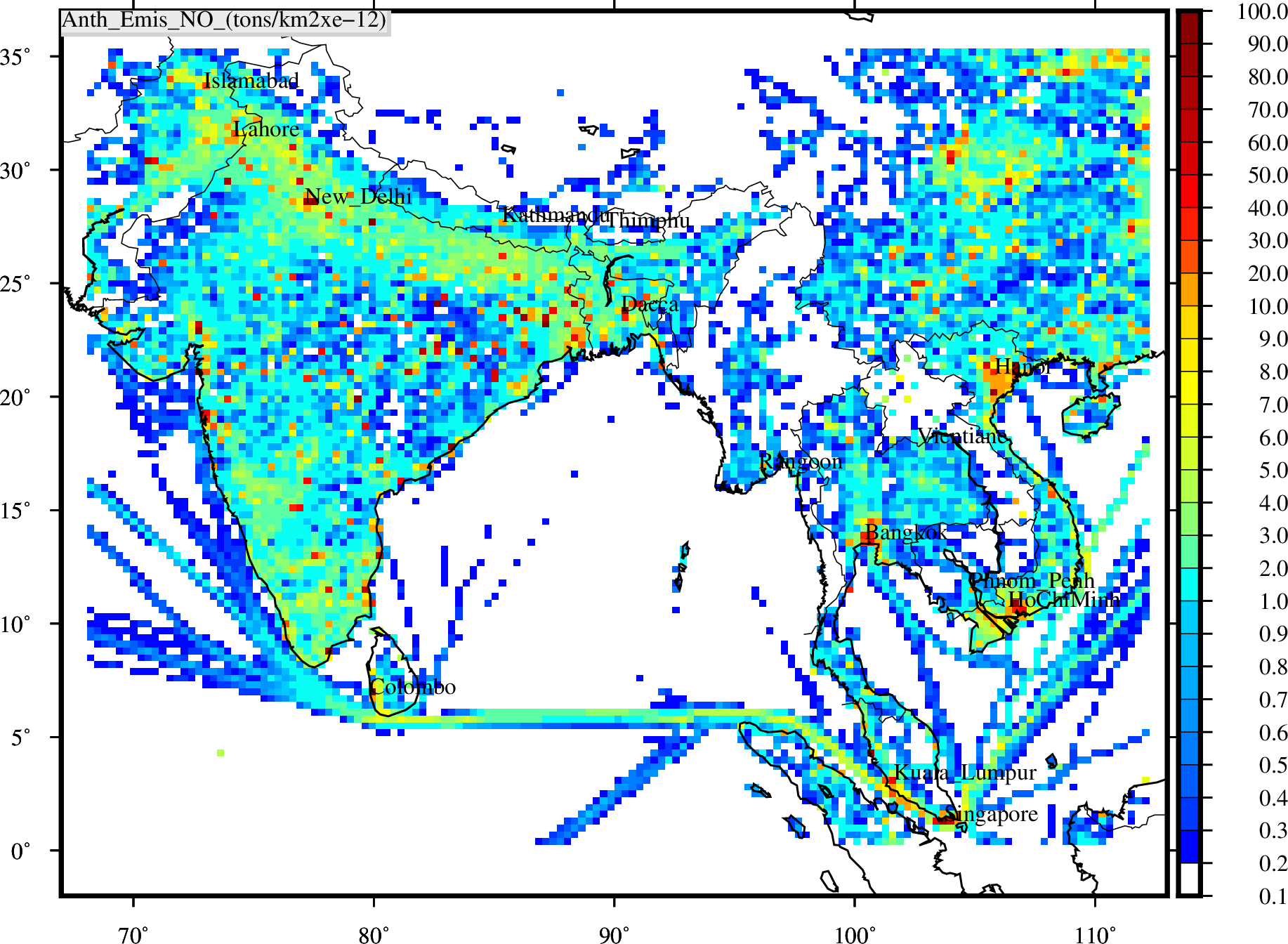
The Observatory will produce daily data through its real-time monitoring network, continuously collecting and calculating data on the concentrations and characteristics of BC/PM 2.5 and associated major atmospheric pollutants, thereby enabling the development of EI and source apportionment. In SEA, as in most developing regions, SLCP sources are numerous and highly variable in intensity, both temporally and spatially, which partly explains the scarcity of reliable emission data. SEACAI aims to improve regional SLCP impact evaluations by adopting a conventional bottom-up approach based on EF and activity data, gathered from field sources and socioeconomic data. The available EI for SEA will be refined using detailed activity data collected for sectors (traffic, industry, residential, open burning, etc.) and consolidated EF for specific sources (cookstoves, charcoal production, domestic waste burning). Appropriate proxies and spatial surrogates will be used for the disaggregation of EI down to a 1x1 km resolution. Refined EI will feed into the database of a centralized data center.