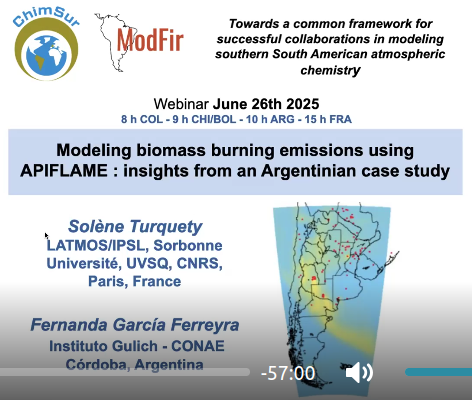
Modeling biomass burning emissions using APIFLAME : insights from an Argentinian
case study,
by Fernanda García Ferreyra (Instituto Gulich - CONAE, Córdoba, Argentina),
and Solène Turquety (LATMOS/IPSL, Sorbonne Université, UVSQ, CNRS, Paris, France
June 26, 2025, 8h COL - 9h CHI/BOL - 10h ARG - 15h FRA
Online (Zoom)
Wildfires contribute significantly to the global atmospheric pollutant budget, with impacts on
air quality both locally and hundreds of kilometers from the source. The APIFLAME model
integrates daily satellite observations of fire characteristics, land cover data, biomass
availability, and emission factors to estimate biomass burning emissions. APIFLAME is
designed for use in chemical transport models, which simulate the dispersion and chemical
transformation of these emissions. In this webinar, the model will be presented by its developer.
Additionally, a case study of large-scale wildfires in Patagonia, Argentina, will be discussed,
followed by a comparison of model outputs (WRF-APIFLAME-CHIMERE) with satellite observations
(OMI, MODIS) of atmospheric pollutants. CHIMERE is a chemistry-transport model that
has been developed from 1997 until now by groups
CLICK FOR THE REPLAY OF THE WEBINAR
DOWNLOAD THE FLYER (pdf)