
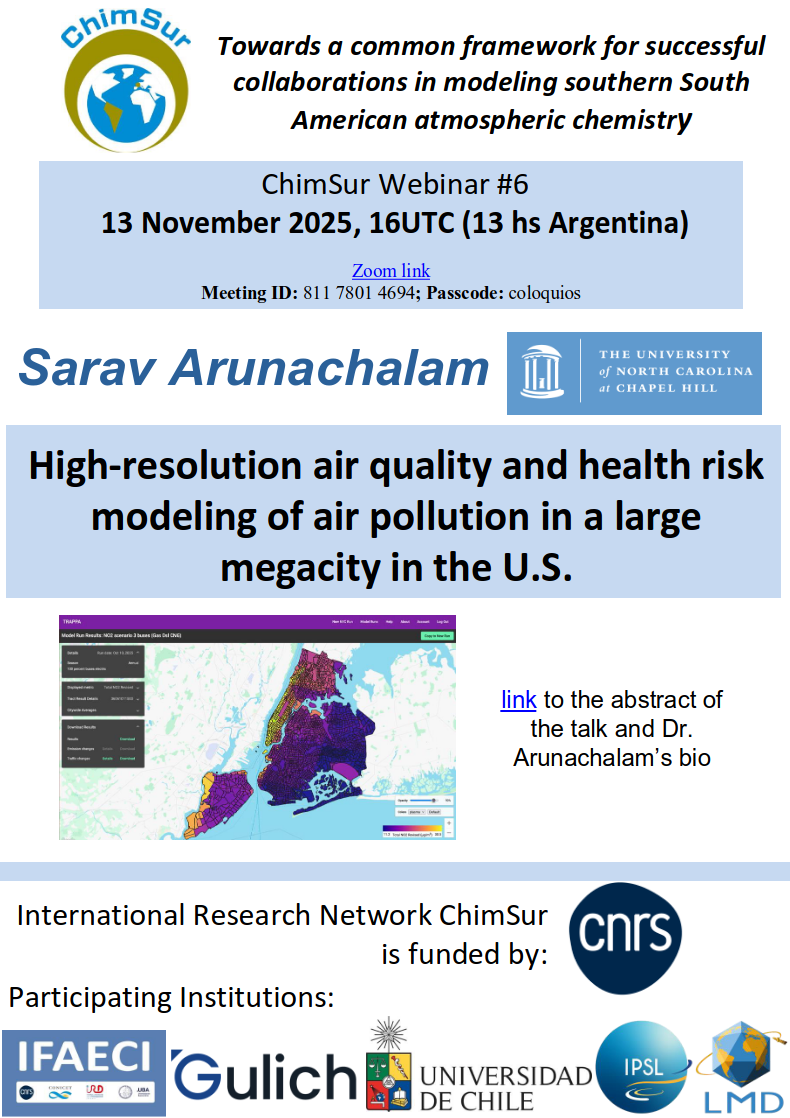
High-resolution air quality and health risk modeling of air pollution in a large megacity in the U.S.,
by Sarav Arunachalam (The University of North Carolina at Chapel Hill)
November 13, 2025, 16UTC (13h ARG)
▶ Video replay of the webinar
Air Pollution Exposure to PM2.5 and NO2 is associated with hundreds and sometimes thousands of
annual premature mortalities in megacities. Current air quality and health impact assessment
tools provide county-wide estimates but are inadequate for assessing health benefits at
neighborhood scales, especially for evaluating policy options related to energy efficiency or
climate goals. This presentation introduces Tract-level Air Pollution Policy Assessment Tool for
New York City (TRAPPA-NYC), a new high resolution web-based modeling tool that integrates two
reduced-form modeling tools to models changes in emissions and associated air quality and
monetized health risks at a census tract scale for New York City. This easy-to-use interactive
tool empowers users to rapidly model specific policy scenarios and quantify health benefits in
the support of policy-making to protect public health and supports modeling both PM2.5 and NO2.
Recent advances to the tool that focuses on better characterization of regional-scale transport
as well as local-scale processes for NO2 will be discussed, along with application of specific
policy scenarios for transportation and energy efficiency measures. We have also expanded this
tool to other large cities including Atlanta and Dallas Fort-Worth, and potential consideration
for adapting this tool to other cities in South America will be discussed.
Dr. Arunachalam, Deputy Director and Research Professor with the UNC Institute for the
Environment and UNC Gillings School of Public Health's Department of Environmental Sciences and
Engineering. He directs the EPA-funded Center for Community Modeling and Analyses System (CMAS)
to provide modeling support for a global user community, and the U.S. DOT funded Center of
Excellence on Aviation Emissions to study aircraft emissions and their impacts on the
environment. Dr. Arunachalam's interests and expertise are in emissions and multi-scale
air quality modeling with a focus on atmospheric chemistry, source apportionment and health
risk assessment. His work has been recognized by the U.S .EPA and U.S. DOT with multiple
awards, and he is a U.S. nominee for multiple committees on the ICAO Committee on
Aviation Environmental Protection (CAEP). He received his Ph.D. in Chemical
Engineering from Rutgers, the State University of New Jersey in 1998.
DOWNLOAD THE FLYER (pdf)