Bertrand Bessagnet
CNRS Scientist - Director of Research
[bertrand.bessagnet @ lmd.ipsl.fr]
[Linkedin]
CNRS Scientist - Director of Research
[bertrand.bessagnet @ lmd.ipsl.fr]
[Linkedin]
Laboratoire de Meteorologie Dynamique
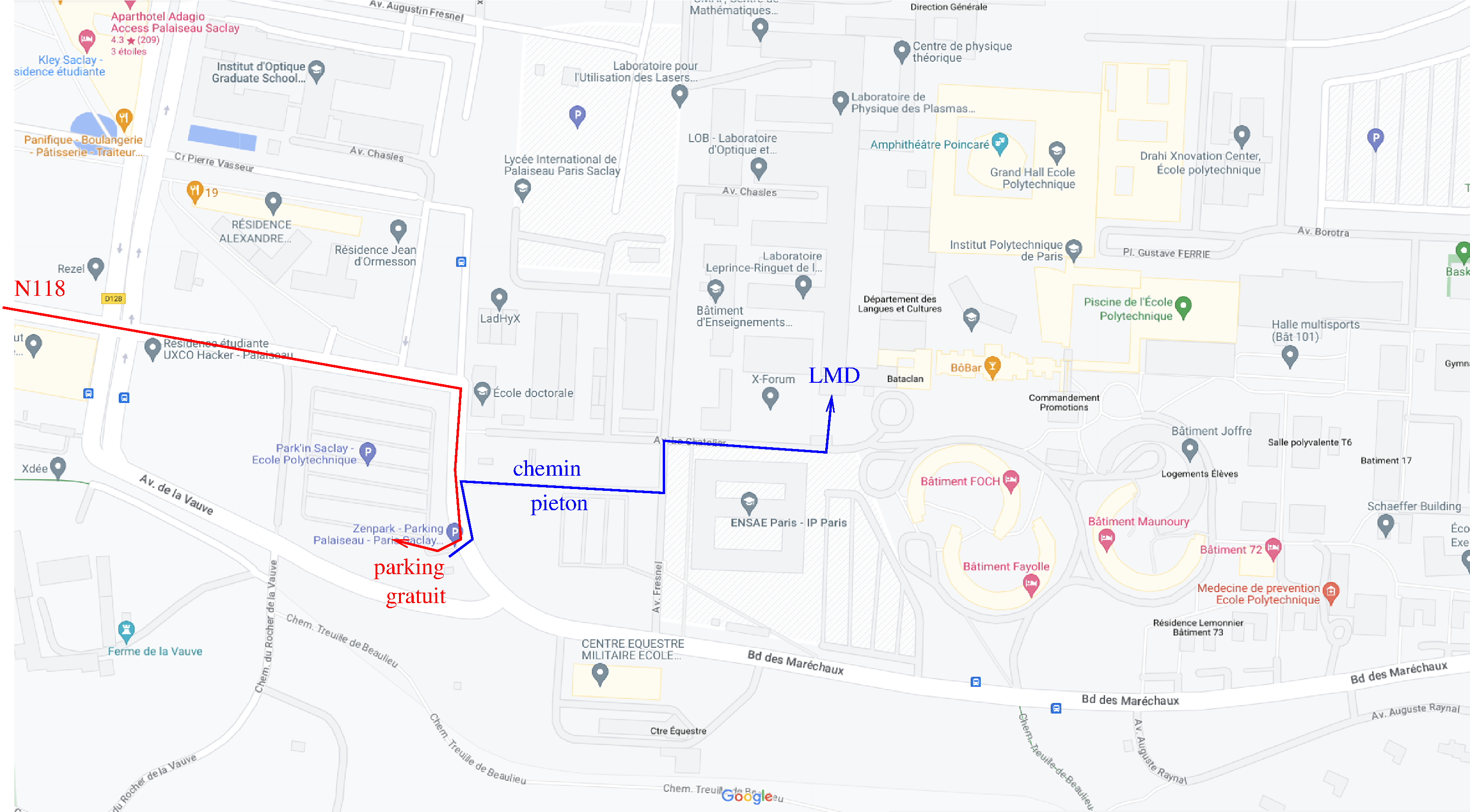
Ecole Polytechnique, 91128 Palaiseau, France [map]
[LMD webmail]
Ecole Polytechnique, 91128 Palaiseau, France [map]
[LMD webmail]

News:
Working on emissions over the South and Southeast Asia at 0.01° resolution

About
Bertrand Bessagnet is a Research Director at the CNRS, which he joined begin of 2025. Previously, he spent a year at ICIMOD (Kathmandu, Nepal) in 2024 as head of the air quality unit. He was previously a senior researcher at the European Commission - Joint Research Centre between 2021 and 2024. He worked in 2020 at Citepa (France) as head of the Air Pollution, Mobility and Territories department. In 2019, he has worked for one year in China to develop a start-up in the field of Air Quality Management services. Between 2001 and 2018, Bertrand Bessagnet served successively as an R&D engineer, unit head, and scientific affairs manager at the French National Institute for Industrial Environment and Risks (INERIS), which he joined in 2001 after obtaining his PhD in atmospheric chemistry and physics in 2000 from Paul Sabatier University (Toulouse). In 2015, he obtained his HDR (Advanced Research Diploma) in atmospheric sciences from Pierre and Marie Curie University (Paris) and is affiliated with Sorbonne University. He also holds two MSc in chemical engineering from the Institut Polytechnique de Toulouse (DEA/research degree and engineering degree obtained in 1997).
His main areas of expertise are: air quality management, exposure to air pollution, modeling, pollutant emissions, climate change, and meteorology. Bertrand Bessagnet contributes to the development of the CHIMERE chemical transport model. He also participated in the management of the PREV'AIR air quality platform, the official national air quality forecasting system in France (www.prevair.org). His research project plans to apply machine learning techniques to air quality models to create tools to simulate pollutant concentrations while reducing the required computation time by several orders of magnitude. He brings to the team his international network (primarily in Asia), where these tools will be applied, this region being critically affected by air pollution.
- Southeast Asia
- SEACAI (2025-)
Integrated approaches to climate mitigation and air quality improvement in Southeast Asia (funded by France, Germany and Swiss agencies, piloted by IRD for France).
- South Asia
- Fostering the collaboration in South-Asia to improve Air Quality over the Indo Gangetic Plain and Himalayan Foothills (a collaboration with the World Bank and ICIMOD).
- The Science Policy and Finance Dialogue on Air Quality Management in IGP-HF

- Europe
- Framing the use of models for the EU Air Quality directive (coordinated by the JRC European Commission and the EEA).
- FAIRMODE

- CHIMERE is an open source multi-scale chemistry-transport model designed to produce (i) accurate analysis of pollution episodes, (ii) daily forecasts of ozone, aerosols and other pollutants, (iii) long-term simulations (entire seasons or years) for emission control scenarios. It runs over a range of spatial scale, from the hemispheric to the urban scale with resolutions from 1km to several degrees.
- web site
- Short Overview
- Wikipedia page: [Fr], [Eng]
- Emisurf
- The anthropogenic emissions pre-processor
- (the code is freely available on the CHIMERE web page)
- emifiresCAMS
- Biomass burning: CAMS preprocessor
- [program]
(the code is freely available on the CHIMERE web page)
- NterGeo
- An interpolation program coded in Fortran for irregular N-dimensional cases is provided and freely available.
- A N-dimensional Fortran Interpolation Program (NterGeo) for Geophysics Sciences

- SHERPA
- A surrogate model developed by the Joint Research Centre of the European Commission to quickly assess air pollution mitigation strategies.
- SHERPA-Cloud: An open-source online model to simulate air quality management policies in Europe

- Machine Learning application
- Test of several neural network architectures to emulate the CHIMERE model to allow quick high resolution simulations (a collaboration between LMD, JRC and IMT-Nantes Atlantique).
- Deep learning techniques applied to super-resolution chemistry transport modeling for operational uses

- Enhancing Air Quality simulations with Neural Network Architectures
- Spatial Downscaling - Towards High Resolution
- A downscaling method has been developed to create high resolution maps of pollutant concentrations. The method is evaluated against observations over Europe. The code is fast and produces a top-down high-resolution inventory, as a side product.
- A simple and fast method to downscale chemistry transport model output fields from the regional to the urban/district scale

- AtmospheIc dispeRsIon Kernel - AIRIK
- The Gaussian atmospheric dispersion theory is widely used to assess the dispersion of an emitting point sources. For the first time, we generalize this concept to possibly millions of emitting grid cells over large domains, with a high spatial resolution (100 m to some kilometers). This code, called AIRIK (as AtmospheIc dispeRsIon Kernel), is freely available and allows for rapid dispersion analysis of multiple emission sources or to inform metamodels with more realistic dispersion conditions. As a perspective, this approach opens new developments to elaborate more physical convolutional filters in neural network architectures for atmospheric dispersion.
- Code here

- Why historical breaking cold records is so rare?
- The occurrence of extreme cold events is expected to decrease with climate change but they will remain an issue to face for the society due to their impact on health, agriculture and infrastructure. Even if these events are less and less frequent, the surge of such event questions the citizens and disturb their perception of climate change. Using a very simple asymmetric indicator called TTA (Temperature Tail Asymmetry) adapted for cold and warm extremes analysis, we analyze such “outliers” or “historical” events compared to their “usual” extremes taken as a reference. We find that particularly in the mid-latitudes of the north hemisphere, historical spells of extreme cold are inherently less frequent than exceptional heat waves. This feature is disconnected from climate change, it is an intrinsic characteristic of the temperature fluctuations due to the property of the atmospheric general circulation, polar vortexes characteristics and geographical patterns.
- Open access publication here
